

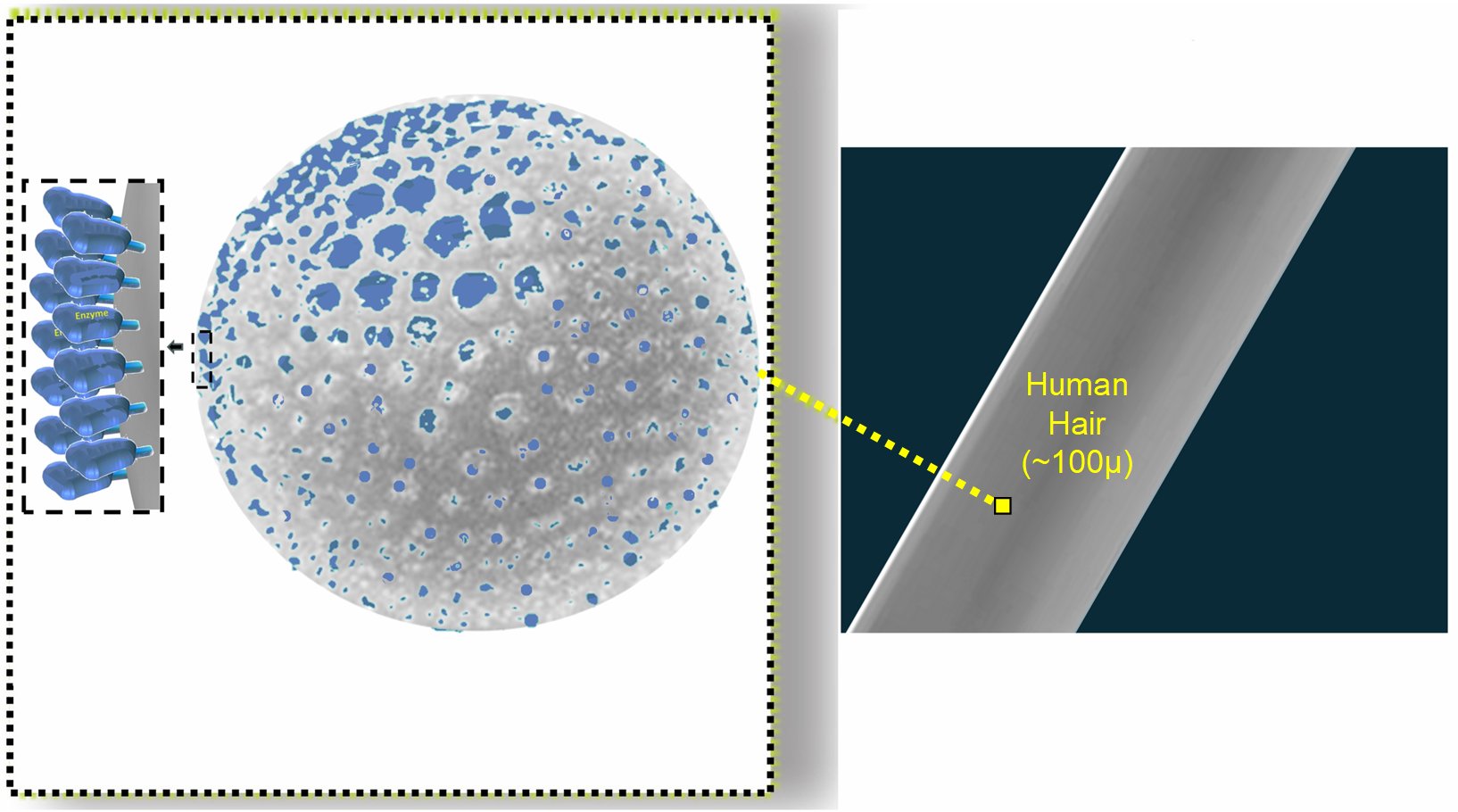
TET Tethered Enzyme Technology (TET) comes from the groundbreaking work by Professor Alex Travis and Roy Cohen at Cornell University that replicates the way that enzymes attach to mammalian sperm providing improved stability and activity. Professors Travis and Cohen have evolved these patented techniques to facilitate fast, high sensitivity catalytic coupled reactions that are first being applied to the detection of biomarkers including proteins, enzymes, viruses and Micro-RNAs.
Initially funded by a prestigious NIH Pioneer Award because of its transformative potential, the underpinnings of our technology have been developed with over $6M in grants and academic support. TET nanobots are capable of performing chemical operations with high sensitivity, specificity, and ultra-rapid speed typically with improved amplification and read-out time faster than when based on antibody-antigen interactions. Tethering of enzymes to nanoparticles also results in extraordinary stability, with NSE-FAST having an early lab-tested freezer shelf life of over one year. Multiple types of nanobots can be combined in test and reaction control wells in our unique 12 well strips, on a standard assay plate or in other assemblies to perform diverse chemical operations such as detection of a wide variety of analytes and biomarkers. TET enables a practically infinite array of possible reactions – a true multi-purpose molecular software platform.
Company History
 Tethered Enzyme Technology (TET) was inspired by nature. Studies of how sperm generate energy to swim revealed that they attach the enzymes that metabolize sugar to a solid structure down the length of the sperm tail. This solid-state design lets them carry out complex reactions in a small space and with high efficiency—producing energy exactly where it is needed. We recognized that if we could copy their design on man-made surfaces such as nanoparticles, then we could create ultra-fast molecular machines, that could perform an almost endless variety of functions. The concept of attaching enzymes to solid structures (i.e., solid state catalysis) has been around for decades, but the most common methods of attachment usually reduce enzyme activity. However, utilizing a biomimicry-based approach, we were able to immobilize enzymes to nanoparticles (NPs) via bio-affinity tags and oriented immobilization, showing that tethered enzyme reactions provide even more efficient coupled activity, and thus higher assay sensitivity, than non-tethered enzymes (https://pubmed.ncbi.nlm.nih.gov/26605916/).
This study published in the highly respected PLoS One Journal, described the first use of TET for detecting brain injury in animal stroke model, and provided proof of concept for TET as a highly rapid and sensitive biomarker detection platform.
Because of the enormous potential for medical diagnostics and therapeutics, our work has received much attention, from our first abstract being chosen for a press release by the American Society for Cell Biology (approximately one of 20 out of 10,000), to significant press coverage of our Pioneer Award from the National Institutes of Health.
On the strength of our pre-clinical data distinguishing patients with brain injury from those with mimics, our solid intellectual property, and the potential enormous clinical and medical impact, Drs. Travis, Cohen and Fischell co-founded TETmedical in November 2021. In 2024 TETmedical has completed the move from Cornell Center for Life Science Ventures incubator to its new home of 11,000sqft housing a state-of-the-art clean room in Cornell Business & Technology Park, Ithaca NY.
Product Development Strategy and Pipeline
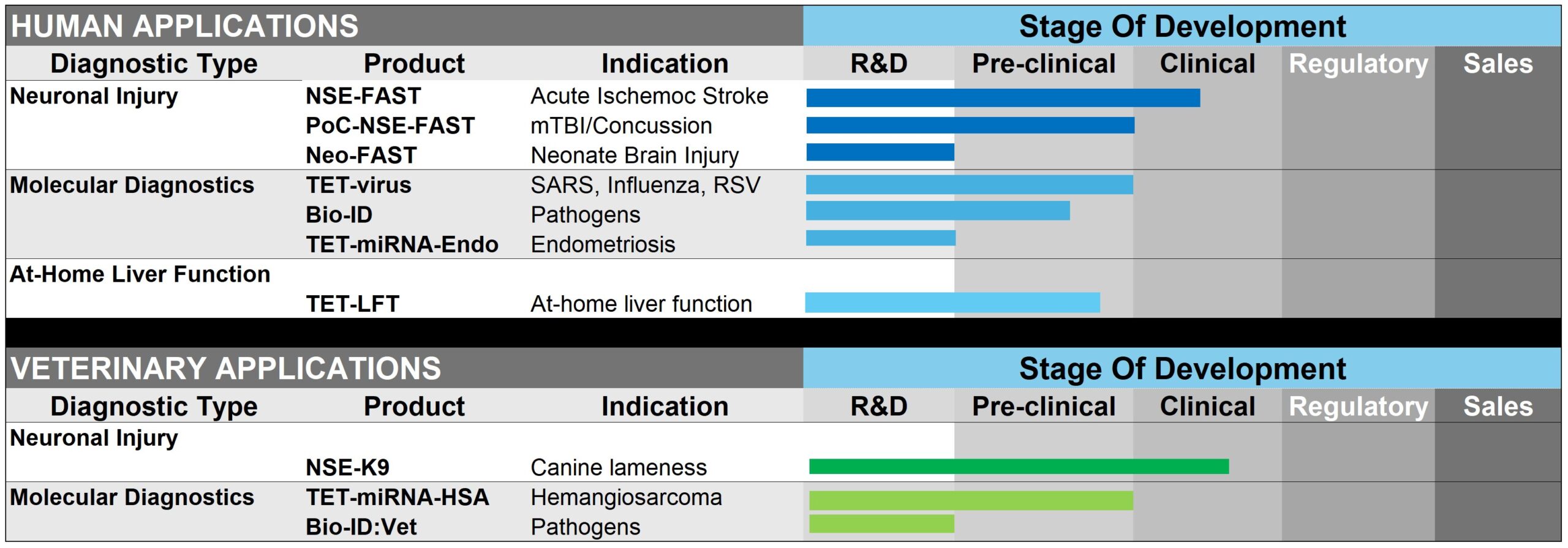
Recognizing that TET enables remarkable sensitivity, speed, and versatility, TETmedical is focusing our first products on medical conditions where rapid, quantitative measurements of biomarkers or analytes are urgently needed, and current diagnostics do not exist. Brain injuries such as stroke presented an obvious first target, and this is our most advanced product in the pipeline, with the NSE Functional Activity Stroke Test (NSE-FAST) preparing for 2026 FDA clinical testing with trial completion in 2027.
In addition to the NSE-FAST, TETmedical’s platform technology continues to expand as we develop tests for other conditions for which there are no adequate diagnostic solutions.
The COVID-19 pandemic presented new medical challenges to the world, including the need to quickly distinguish respiratory viral infections (e.g., influenza, COVID-19, or cold). Inspired by this urgent need, we devised new TET-based modalities for rapid diagnosis of viral infections from both RNA and DNA viruses. These IVD tests work in minutes, do not require thermocycling, are highly sensitive, and can detect a specific pathogen variants and subtypes. This work is supported through 2026 by a 3 year $2M Phase I and Phase II New York State Biodefense Commercialization Grants to develop a point-of-care differential diagnostic test for RNA and DNA respiratory viruses.
In parallel with these efforts, we have also developed a rapid TET-based liquid biopsy test (LBT). Using a similar strategy of identifying a medical need where rapid diagnosis is essential but no diagnostics currently exist, we chose to develop as a first product in this line, a point-of-care LBT for canine hemangiosarcoma. Work at Cornell from the Baker Institute for Animal Health is underway to identify candidate target markers for differential diagnosis of canine hemangiosarcoma from similar conditions, which we will integrate into our rapid TET-based test. We are now performing early-stage product development toward this goal. Future TET products in this category will include rapid LBT for endometriosis and breast cancer, with the goal to potentially enable an alternative to painful and costly biopsies and mammograms.
On other directions, TETmedical began work supported by a Phase I NIH STTR grant to develop an at-home test capable of measuring ALT and AST without the need for venipuncture. These enzymes are the most common measures of liver function, identification of liver injury and track progression of liver disease. We have already demonstrated that TET biosensors can be integrated with blood separation via a simple lateral flow device. Coupling an existing at-home blood collection product with TET’s patented biosensors would eliminate the need for repeated visits to a clinical lab, or repeated home visits by a skilled nurse, needles, etc., opening a door for at-home testing to improve patient outcomes, while simultaneously reducing burden on patients and reducing costs for payers.
TETmedical’s future is exciting with the below diagram showing the status of our current pipeline of applications.
Scientific Papers
- Effects of Nanoparticle Size on Multilayer Formation and Kinetics of Tethered Enzymes
- Biomimicry Promotes the Efficiency of a 10-Step Sequential Enzymatic Reaction on Nanoparticles, Converting Glucose to Lactate
- Use of Tethered Enzymes as a Platform Technology for Rapid Analyte Detection
- Improved monitoring dynamics through use of a tethered enzyme biosensor to detect and quantify neuron-specific enolase activity levels in biofluids
- Biomimicry Enhances Sequential Reactions of Tethered Glycolytic Enzymes, TPI and GAPDHS
- The Potential for microRNA Therapeutics and Clinical Research
- Neuron-specific enolase enzymatic activity as a biomarker to discriminate neurologic and orthopedic gait abnormalities in dogs
Patent Information
PATENT FAMILIES
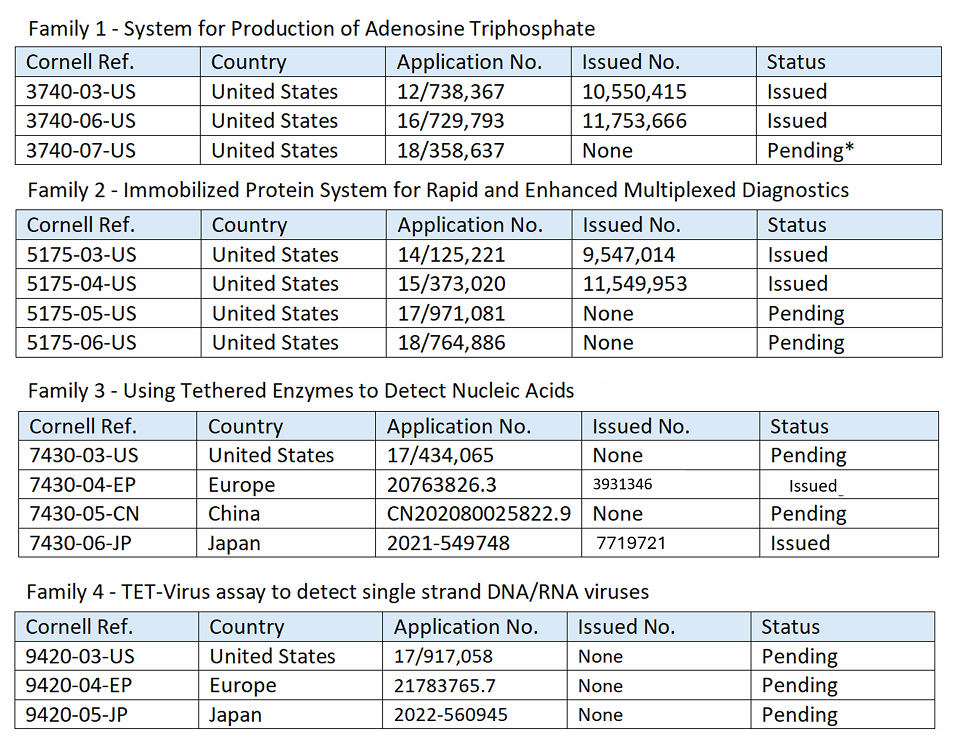
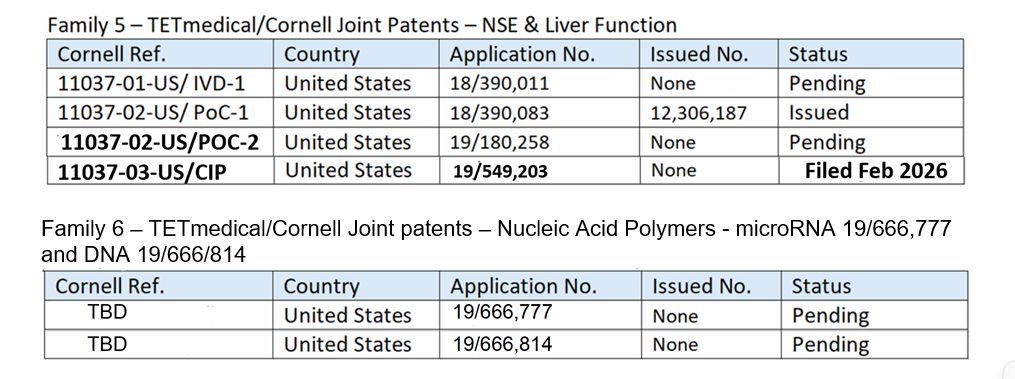
There are 5 families of issued and pending patent patents as shown in the table below. These
include 4 families of licensed IP from Cornell University and 1 issued and 4 pending patent
applications in two families that are joint patents of TETmedical and Cornell that are exclusive to
TETmedical by Cornell under a 2022 Memorandum of Understanding (MOU)
CORNELL LICENSED PATENTS
Pursuant to the FastTrack Startup License Agreement, dated August 25, 2022 by and between
the Company and Cornell University, Cornell University granted the Company an exclusive
license to the following four (4) families of patents:
 CORNELL/TETMEDICAL JOINT PATENTS
TETmedical and Cornell University Signed a Memorandum of Understanding (MOU) in
August 2022 covering joint inventions defined as inventions having both TETmedical
inventors and Cornell University inventors (i.e. Faculty, employees etc.). Under this
MOU that grants TETmedical an exclusive license for Cornell’s Non-exclusive
Ownership of such inventions.
The table below shows the current status of such Joint Inventions.
Trademarks: NSE-FAST.
Copyrights: None.
Domain Names: tetmedical.com and tetdiagnostics.com
TETMedical Filed Patents
In December 2022 TETmedical filed its first patent as a provisional patent covering the innovative design of the NSE-FAST including the design of the 12 well TET strip, production of the enzymes used, the tethering process, the process for layering the components into test, positive and negative control wells and concepts for at home and point of care use of TET for diagnostic applications. New patents are being developed for design of the products that use TET for virus and micro-RNA diagnostic applications.
Grant Funding Status
In addition to equity funding of the company, TETmedical/Cornell is currently funded from 3 grants totaling $1.25M with applications in for another $1.4M of grants.